
A Neighborhood with Deep Agricultural Roots
Countryside Woods may feel like a comfortable suburban neighborhood today, but its story reaches back well before curving streets, cul-de-sacs, and family homes filled the east Vancouver landscape. The neighborhood sits in the traditional Mill Plain area, roughly seven miles east of downtown Vancouver, between NE 6th Street and NE 18th Street and between 153rd Avenue and 162nd Avenue.
Mill Plain was historically known as a broad, level, relatively open landscape. Its flat terrain was shaped in part by ancient glacial flooding associated with Lake Missoula, which left behind sand, gravel, and larger stones. Long before residential development, the area was used as open land and farmland, with a rural character that lasted well into the twentieth century.
That agricultural past remains an important part of Countryside Woods’ identity. Although most residents know the neighborhood as a collection of quiet residential streets, the land beneath the homes was once part of a working countryside connected to the broader Harmony and Mill Plain communities.
The Young Family Farm
One of the earliest documented landowners associated with the area was John Antone Young, a German immigrant who owned property here in 1889. Young and his family built a home on a farm in what was then considered the community of Harmony.
The Young family’s presence places Countryside Woods within the larger pattern of nineteenth-century settlement in Clark County. Families arriving in the region often established farms on the open plains east of Vancouver, where the level ground was easier to cultivate and the growing city was still close enough for trade, supplies, and social connections.
There is no indication that the neighborhood was named directly for the Young family. Instead, “Countryside Woods” appears to be a later suburban name reflecting the area’s blend of rural origins, mature trees, and wooded residential setting. The name is especially fitting today: many streets are shaded by established landscaping, and the neighborhood still retains a peaceful, semi-rural feeling despite being surrounded by modern development.
From Open Land to Subdivisions
Countryside Woods began taking its present form in the early 1980s. The easternmost section was developed first, followed by a series of subdivisions built by different developers over several decades.
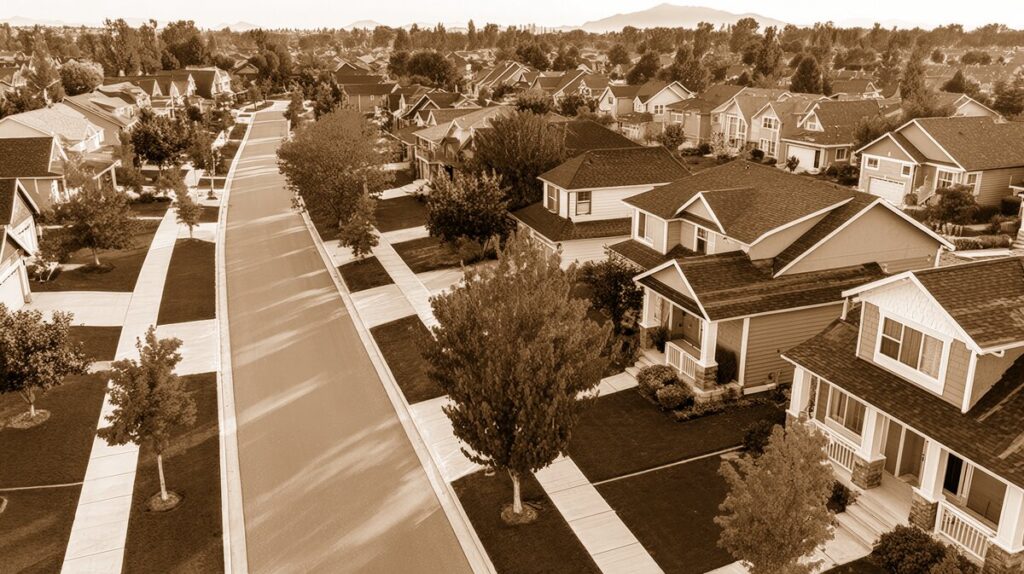
That gradual development helps explain why the neighborhood does not have a single architectural style. Some homes reflect the popular designs of the early 1980s, while others were built later as the surrounding streets and lots filled in. The result is a varied but cohesive residential landscape, with traditional-looking houses, split-level designs, larger lots, and newer construction existing side by side.
The neighborhood’s layout also reflects its suburban era. Rather than relying on a rigid grid, many streets bend into circles, loops, and cul-de-sacs branching from the main routes. NE 7th Street, also known as Bluegrass Drive, and 155th Avenue serve as important internal corridors. These winding streets create quieter pockets and give many homes a degree of privacy.
- The neighborhood encompasses roughly 100 square blocks.
- More than 700 homes were identified in the early 2000s neighborhood profile.
- Development occurred in stages rather than as one unified project.
- Mature trees and varied lot sizes help preserve a traditional residential character.
The Name “Countryside Woods”
The name captures the transition that defines the neighborhood. “Countryside” points back to the open fields, farms, and rural roads of old Mill Plain. “Woods” reflects the tree cover that emerged as homes were built and residents planted yards, gardens, and street trees.
Unlike neighborhoods named for a single historical figure or landmark, Countryside Woods seems to have received a descriptive name connected to its atmosphere. The name evokes a place that is near shops and schools but still feels tucked away from the busiest parts of Vancouver.
That balance remains one of the neighborhood’s most recognizable qualities. A person walking near the neighborhood’s quieter loops can experience a distinctly different pace from the commercial activity along nearby arterials. The streets feel residential and sheltered, even though everyday services are often within walking distance.
Fisher’s Grange and Other Reminders of the Past
One of Countryside Woods’ most notable historic features is Fisher’s Grange. The grange represents the agricultural and community institutions that once played a central role in rural Clark County. Grange halls traditionally served as meeting places for farmers and families, hosting social gatherings, educational programs, discussions, and community events.
Its presence gives the neighborhood a physical connection to the era when the surrounding land was more rural than suburban. Along with the area’s older roads, open parcels, and mature vegetation, Fisher’s Grange helps tell the story of a community that developed gradually rather than appearing all at once.
The neighborhood also includes a church and a gravel pit, reminders that Countryside Woods is not exclusively residential. These uses reflect the mixture of civic, agricultural, industrial, and residential activities that often characterized the outskirts of growing towns.
Countryside Park Becomes a Community Gathering Place
A major milestone came in November 2000, when the three-acre Countryside Woods Neighborhood Park was completed. Today listed by the City of Vancouver as Countryside Park, the approximately 2.3-acre park serves local families with a playground and open gathering space.
The park is modest in scale, but its importance is larger than its acreage. In a neighborhood built from separate subdivisions, a shared public space helps create a sense of common identity. Children have a place to play, neighbors have a natural meeting point, and families can enjoy outdoor time without leaving the community.
The park also reflects the neighborhood’s evolution. Countryside Woods was no longer simply a collection of newly constructed homes by the turn of the twenty-first century. It had become an established community with its own association, traditions, and public gathering places.
Building a Neighborhood Community
The Countryside Woods Neighborhood Association was recognized by the City of Vancouver on May 21, 2001. That recognition marked another important step in the neighborhood’s history.
Neighborhood associations give residents a way to work together on issues such as traffic, safety, parks, maintenance, communication, and community events. In Countryside Woods, the association has helped preserve the neighborly atmosphere that can be difficult to maintain in a large suburban area.
The neighborhood has also become known for its holiday light displays. Each winter, decorated homes bring residents and visitors out for evening drives and walks. It is a simple tradition, but one that captures the warmth of Countryside Woods: private homes become part of a shared seasonal experience.
Countryside Woods Today
Today, Countryside Woods is a mature east Vancouver neighborhood shaped by several generations of change. The earliest homes are now more than four decades old, while many trees and gardens have had years to grow into the landscape. Streets that once led through new subdivisions now connect established homes, schools, shops, and community spaces.
Local children have historically attended Mill Plain and Hearthwood elementary schools, Pacific Middle School, and Evergreen High School, tying the neighborhood to the broader Vancouver Public Schools community. Nearby commercial areas provide convenient access to groceries, services, restaurants, and everyday necessities.
Still, the neighborhood’s strongest appeal is not simply convenience. It is the way Countryside Woods preserves traces of its past while continuing to adapt. The old Mill Plain landscape survives in the name, the open feeling, the mature trees, and the presence of Fisher’s Grange. The newer history lives in Countryside Park, the neighborhood association, holiday traditions, and the many families who have made the area home.
For longtime residents, Countryside Woods is special because it feels settled without feeling closed off. It is a place where a rural past, a suburban present, and an active community life meet along the winding streets of east Vancouver.